


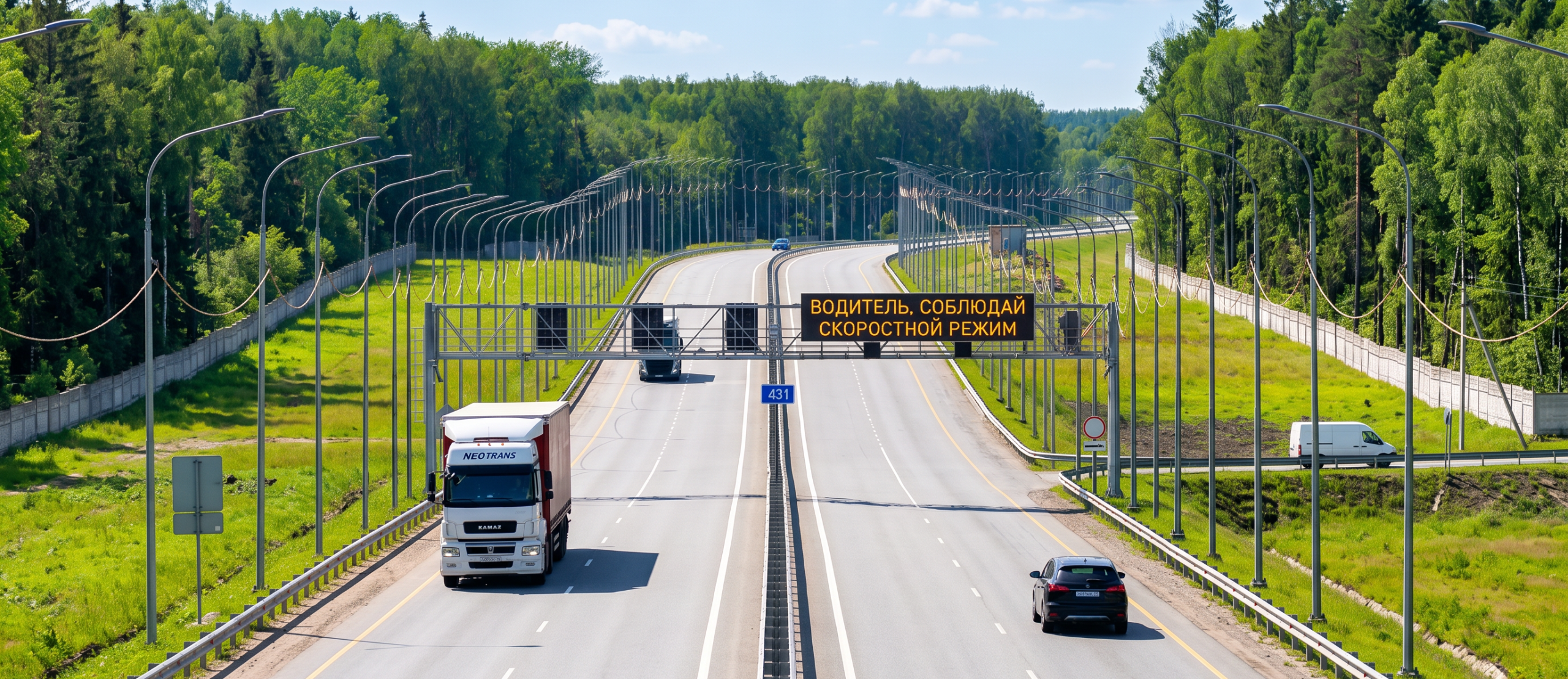
Design of Automated Traffic Control Systems (ATCS)
To ensure safety, increase road capacity, and respond promptly to changes in traffic conditions, a comprehensive approach based on modern digital technologies is necessary. That is why, in recent years, an increasing number of cities in Russia have been implementing automated traffic control systems (ATCS).
An Automated Traffic Control System (ATCS) is a set of technical, software, and information tools designed to manage traffic flows at transportation infrastructure facilities. It is one of the key subsystems of an Intelligent Transportation System (ITS).
ITS integrates various services for managing transportation infrastructure, monitoring, informing road users, and analyzing data. The ATCS is directly responsible for the automated regulation of traffic and the coordination of the technical equipment used to manage it.
What Is an Automated Traffic Control Systems (ATCS)
The first group is located at the central control center. It includes a hardware-software complex designed to collect, process, and analyze incoming information, as well as to centrally monitor the system’s operation.
The second group consists of the peripheral complex of the ATCS, installed directly on the roadway. Its equipment collects data on current traffic conditions, environmental conditions, and traffic flow parameters, transmits this information to the central control center, and executes control commands.
The main elements of the ATCS road infrastructure include:
- road controllers (RC) — devices that control connected equipment and execute specified algorithms;
- variable message signs (VMS) — devices for displaying real-time messages to road users;
- changeable message signs (CMS)—electronic road signs that allow the displayed information to be changed depending on the situation;
- traffic detectors (TD)—equipment for recording and determining traffic flow parameters;
- automatic road weather stations (ARWS)—systems for monitoring weather and road conditions;
- video cameras (VC) — devices for visual monitoring of road conditions;
- emergency call system (ECS) — equipment for establishing emergency communication with an operator or a dispatch center.
The ATCS consists of two interconnected groups of hardware and software
The primary objectives of the ATCS are related to improving the efficiency and safety of highway operations. The system is designed to address the following tasks:
- minimizing the number of traffic accidents and reducing the severity of their consequences;
- creating more comfortable and predictable conditions for traffic flow;
- increasing the traffic capacity of a road section through efficient traffic flow management;
- reducing the negative impact of motor vehicle traffic on the environment.
The operation of the ATCS enables comprehensive management of traffic conditions. Specifically, the system provides for:
- improving the overall safety of road users;
- rapid detection of abnormal and emergency situations, with the ability to promptly implement the necessary response measures;
- providing drivers with up-to-date information on traffic conditions, restrictions, and changes in traffic conditions;
- regulating and adjusting speed limits based on the current situation;
- maintaining the required traffic and operational characteristics of high-speed sections of the highway;
- reducing financial costs associated with the operation and use of road infrastructure;
- improving the efficiency of organizations responsible for road maintenance and operation by providing them with timely and reliable information;
- reducing road maintenance costs by more accurately determining the scope and timing of maintenance work.
Tasks Addressed by the ATCS
Get more information about the company
+7 (812) 775-10-82 ( Mon-Fry 9:00 AM - 06:00 PM МСК) office@ntc-ksm.ruSTC “IMS” provides a full range of services for the design of ATCS. When developing a project, our specialists take into account the specific characteristics of the infrastructure, traffic volume, regulatory requirements, and the client’s objectives.
Depending on the facility’s configuration, the design of the automated traffic control system may include:
- design of traffic flow monitoring subsystems using traffic detectors, video cameras, and other equipment for data collection and analysis;
- design of systems for informing road users, including variable message signs and other real-time notification devices;
- the design of video surveillance and automatic event recording systems that enable monitoring of traffic conditions and the timely detection of abnormal situations;
- the development of a traffic signal control system with the capability for centralized monitoring and modification of operating modes from the control center;
- development of solutions for integrating the automated traffic control systems with other elements of the intelligent transportation systems and existing road infrastructure.
Each project is developed on a case-by-case basis. This approach allows for the creation of a reliable automated traffic control system that is tailored to the specific characteristics of the facility, ensures the effective operation of technical equipment, and can be scaled as the transportation network expands.
How STC “IMS” Implements ATCS
One of the major projects undertaken by the Scientific and Technical Center “Integrated Monitoring Systems” was the design of electrical facilities for the ATCS on Section 7.1 of the M-12 “Moscow–Nizhny Novgorod–Kazan” highway, currently under construction. The work was carried out as part of the main construction phase of the highway on the section from the intersection with Federal Highway A-151 “Tsivilsk–Ulyanovsk” to the eastern border of the Malopodberezensky Forest in the Chuvash Republic and the Republic of Tatarstan.
Specialists at the STC “IMS” were tasked with developing working documentation for the external power supply to the ATCS facilities that are part of the expressway’s intelligent transportation system. Particular attention was paid to creating engineering solutions that ensure a reliable power supply to the equipment responsible for managing the road infrastructure and the uninterrupted operation of all system components.
The design took into account the specific characteristics of a long-span linear facility, requirements for power supply reliability, the potential for future expansion of the transportation infrastructure, and the need to integrate the ATCS equipment with other subsystems of the intelligent transportation systems. This approach ensures the stable operation of technical equipment regardless of road conditions and maintains the system’s effective functioning along the entire stretch of the highway.
The project resulted in the preparation of a complete set of working documents necessary for implementing solutions for the external power supply to the ATCS facilities. The work carried out became part of a large-scale federal project to construct the M-12 highway—one of Russia’s most important modern transportation arteries, designed to increase the capacity of the road network and reduce travel times between the country’s regions.
Completed Project
At the STC “IMS”, the design of automated traffic control systems represents an expert synthesis of a customized approach and strict regulatory requirements. We design traffic control systems so that they integrate seamlessly into the existing infrastructure and fully comply with industry standards. Our projects are based on the fundamental standards of GOST 24.501–82 and the technical specifications of GOST 34.401–90, which guarantees their quality and legitimacy.
The STC “IMS” team consists of design engineers, programmers, and analysts, enabling us to carry out the entire scope of design work in-house. This approach ensures high-quality design documentation, seamless collaboration among specialists, and adherence to established deadlines.
Each ATCS project is developed on a case-by-case basis. When preparing technical solutions, the team takes into account the characteristics of the road network, traffic volume, the client’s objectives, the project’s development prospects, and the available budget. This allows for the selection of the optimal combination of equipment and software for both individual road sections and large-scale transportation projects.
The STC “IMS” performs a full range of services for the design of automated traffic control systems and also develops intelligent transportation systems, in which the automated traffic control system is one of the key subsystems.
Design of Automated Traffic Control Systems

Automated Traffic Control System and Toll Collection System of the Moscow – Nizhny Novgorod – Kazan route
Design of system-wide solutions for an intelligent transport system on the Moscow – Nizhny Novgorod – Kazan highway under construction

Automated Traffic Control System of the tramline, Samara
Design of Automated Traffic Control System for the reconstruction of the tramline in Samara

Automated Traffic Control System, Road integrated communication system, Startseva St. – Oktyabryat Avenue – Tselinnaya St. crossing
Design of Automated Traffic Control System and a road integrated communication system on “Startseva St. - Oktyabryat Avenue - Tselinnaya St. crossing” Highway under construction
- office 408, 4, lit. K, Fuchika St., St. Petersburg, 192102, Russia
- +7 (812) 775-10-82
- office@ntc-ksm.ru
- Opening hours: Mon-Fry с 9:00 AM до 06:00 PM MSK